
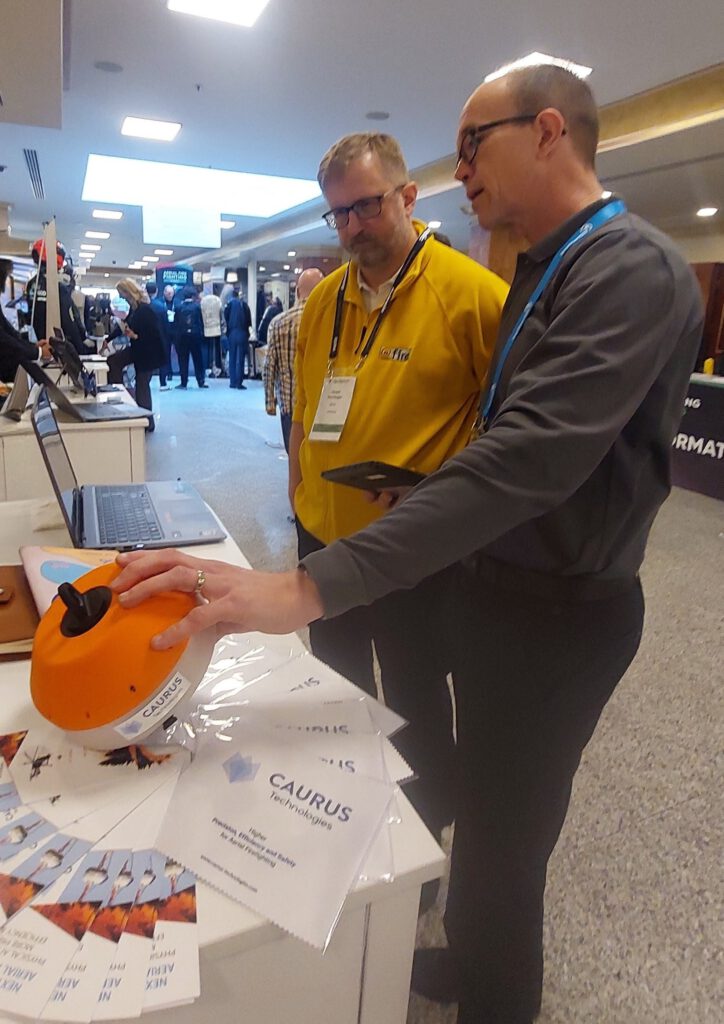
Rome, March 2026 – The annual Aerial Fire Fighting Global Series: Conference and Exhibition, held on 25–26 March 2026 at the Rome Marriott Park Hotel, brought together the world’s leading aerial firefighting authorities, operators, researchers and innovators. And the agenda sent a clear message: “more capacity and resources” cannot be the single solution to addressing rising fire risks. This year’s conference provided a compelling backdrop for the promotion of continued innovation as well as collaboration with and for the emergency forces who protect others: exactly the kind of next-generation, digitally guided extinguishing technology that CAURUS Technologies is developing.
A global crisis that demands new answers
The conference opened with a stark assessment of the scale of today’s challenge. A presentation titled “Up in Flames” noted that wildfires in Europe are escalating — not just in intensity, but in frequency, unpredictability, and geographic spread. 2025 became the worst year on record, exceeding 1 million hectares burned by October. And while fires around Los Angeles alone caused US$ 40 billion in insured damages, we learned that to arrive at the total economic loss we would have to apply a multiplier factor of >5.
The “Up in Flames” report further highlighted again that the traditional model of short, contained summer fires no longer holds: fire seasons are now longer, hotter, and increasingly simultaneous across regions, sometimes overwhelming even the best response systems. Against this backdrop, the conference’s clear focus on new technology integration was both timely and necessary.
Sensors and data: the new language „layers“ of aerial firefighting
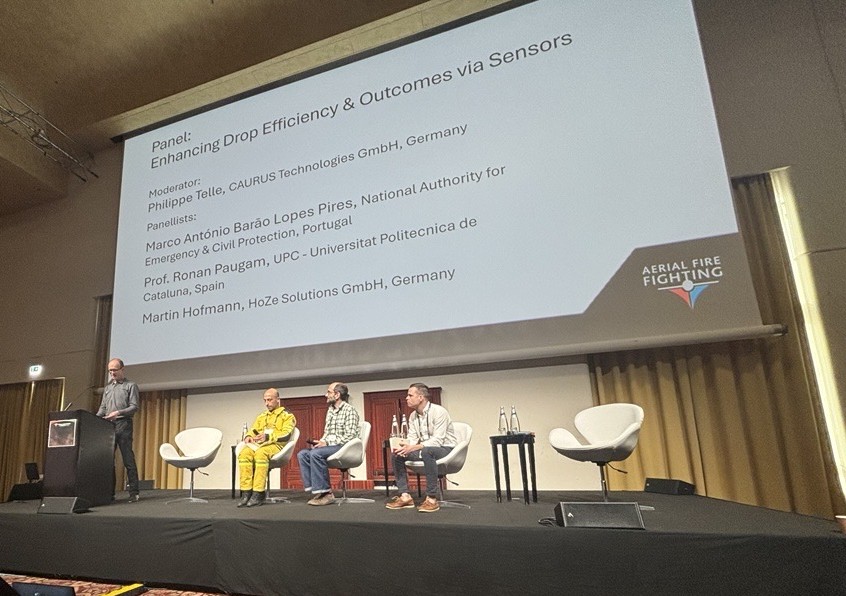
At this year’s Aerial Fire Fighting conference CAURUS Technologies had the honor to moderate a dedicated panel on “Enhancing Drop Efficiency & Outcomes via Sensors.” Together with the panelists from across Europe —including a researcher from the Universitat Politècnica de Catalunya, the assistant fire commander from Portugal’s National Authority for Emergency & Civil Protection and a representative from HoZe Solutions, another startup company — we examined how new sensor-based approaches can significantly enhance mission efficiency and translate into enhanced outcomes in firefighting. The discussion focused on how real-time sensor data is transforming what is possible in and from the air. This is precisely the domain in which CAURUS Technologies operates: the company’s digital guidance system uses HD and infrared cameras, sensors, edge computing and transmitters to capture fire conditions on the ground, identify optimal drop timing and location based on heat profiles, and transmit maps and analysis directly to incident command.
Equally significant was the session on “Data & its Effective Implementation for the Aerial Mission,” which explored how the dramatic increase in sensor capacities — via UAS, aerial means, and ground-based sensors — is enabling game-changing improvements to the aerial fire mission, and how best to integrate this data to optimise outcomes. CAURUS Technologies’ system architecture is built precisely around this principle: closing gaps between detection and reaction, giving operators real-time performance evaluation and continuous AI-driven learning to achieve more with (scarce) assets deployed.
Drones and UAS: mission integration is accelerating
Another panel explored the continuous adoption of Uncrewed Aircraft Systems (UAS) in wildfire surveillance and detection, noting that this is becoming ubiquitous globally, while acknowledging that integrating UAS operations into legacy structures — including asset selection and training — presents significant challenges for interoperability. CAURUS Technologies’ sensor platform is designed for deployment on conventional helicopters and adaptable to drones, meaning it can serve the existing fleet while simultaneously enabling the UAS-driven future the sector is moving toward — without requiring operators to change their procedures or incident command structures.
The industrial response: digital and integrated
On the industry side, Leonardo presented its multi-domain aerial firefighting approach, highlighting how integrated digital and space technologies enhance the effectiveness of their aircraft and helicopter fleet. Airbus described its work developing an integrated ecosystem designed to enhance collaboration and interoperability among all stakeholders — with the goal of providing an agnostic, global approach to wildfire fighting incorporating advanced aerial firefighting capabilities and innovative connectivity solutions. Both presentations underlined the potential of digitally-connected, data-driven firefighting operations — the very direction CAURUS Technologies has been developing since its founding in 2022.
Italy’s fire brigade presentation on “Advanced Technologies Improving Italian Fire Brigade Outcomes” explored how Italy assesses and incorporates new technologies and the key learnings being applied to assess and integrate new capabilities into the aerial fire mission.
Water efficiency: the overlooked frontier
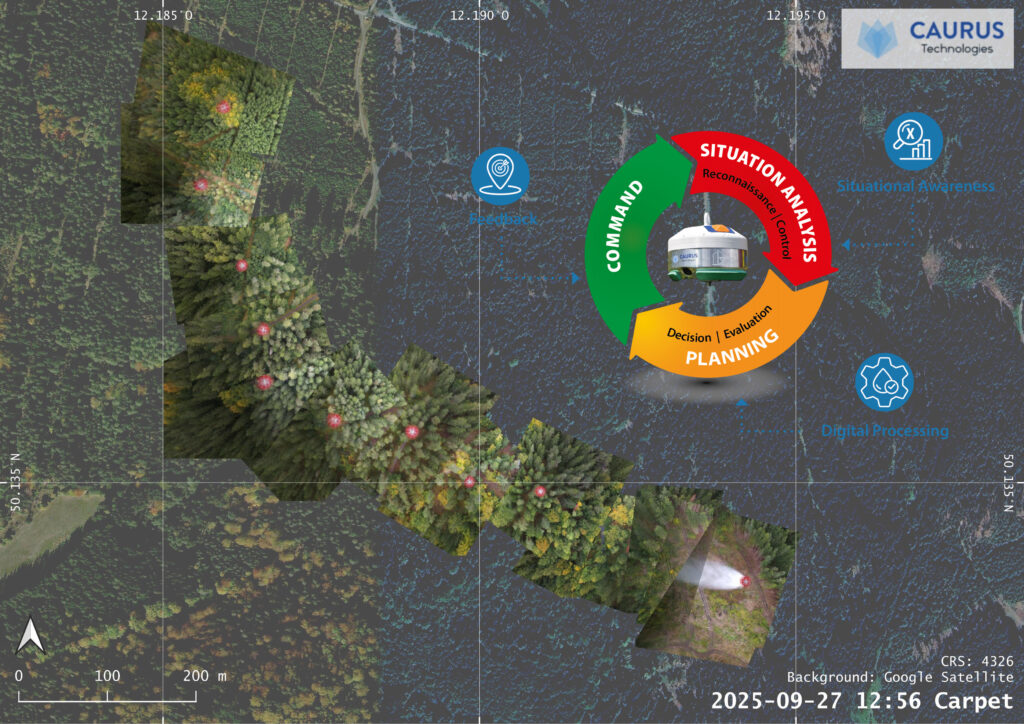
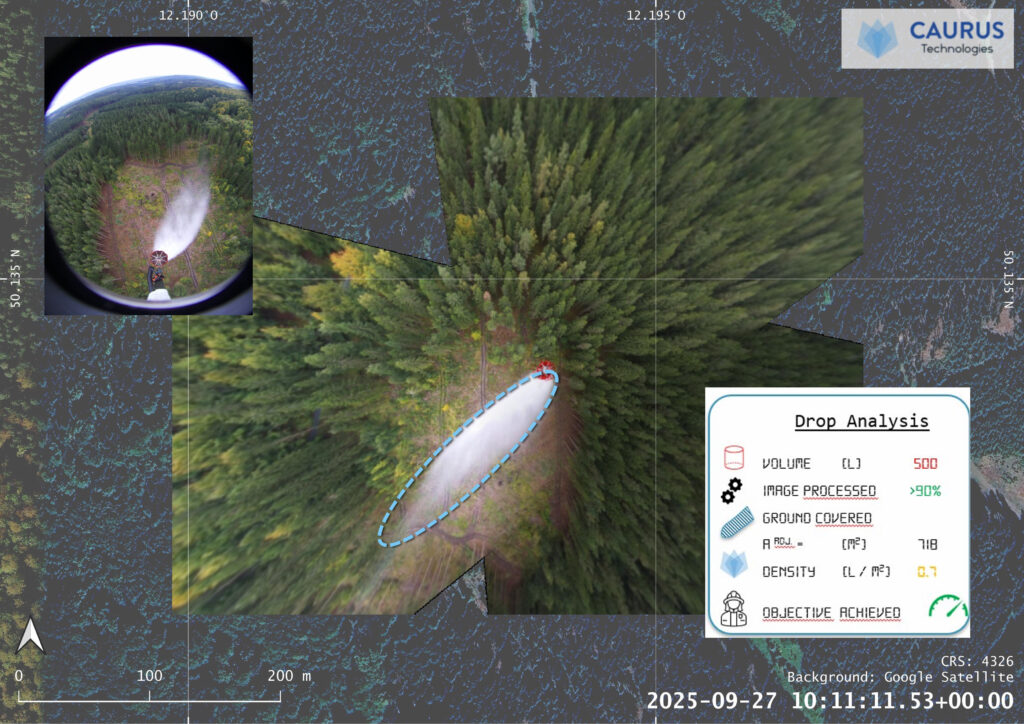
What the conference made clear — and what CAURUS Technologies has been building toward — is that the aerial firefighting sector recognises that data for precision and efficiency are now the central challenge, not just aircraft and ground forces’ availability. Conventional methods still drop water at altitude and speed above vegetation, causing evaporation and wind losses before the water reaches the fire. CAURUS Technologies’ future closed water container is expected to deliver 100% of the water through tree canopy directly to the combustion zone. There, a safe dispersion mechanism generates an aerosol-water cloud with up to ten times the cooling efficiency compared to today’s bulk water drops. The result: a new tool for mission profiles and a potential reduction in total firefighting costs of up to 80%. In times of increasing water shortage, this provides a welcome opportunity to save on water used for firefighting and reducing fire emissions.
With more than 20 successful test flights completed since summer 2024, subsequent aerosol-water cloud lab test series validated, CAURUS Technologies is ready to contribute to exactly the kind of systemic improvement the Rome conference called for.