

INTERSCHUTZ 2026 has come to a close. And one thing became very clear: In an increasingly hot world, which is increasingly characterized by wildfires and water scarcity, efficiency in firefighting on the ground and from the air is becoming ever more important. It was particularly noteworthy that even the water-rich Netherlands are building a team of fire analysts to prepare for the rapidly advancing threat of wildfires. And just a few weeks ago, they even requested assistance from RescEU—a strategic reserve of European disaster response capabilities established by the European Commission. Among other things, equipment and reinforcements were brought to the Netherlands from France, a country with extensive experience in firefighting. The goal here was to use expertise and equipment to help transport water quickly and effectively to the fire source.
Established exhibitors and young startups showcased a wide range of potential approaches to improve complex ground and aerial operations during wildfires. The strong presence of solutions for fire prevention, detection, monitoring, and suppression, for coordinating operations as well as heavy and expensive equipment such as helicopters, aircraft, and specialized vehicles, underscored the growing threat that wildfires pose to people, nature, and critical infrastructure. Effective and cost-efficient risk preparedness, as well as the management of all resources in an emergency, remain a challenge for experts, authorities, and government officials.
Water scarcity drives innovation
Furthermore, simply dropping (even) more water into or onto the fires is not a solution. When, in an operation like one in 2025, up to 40,000 liters of drinking water per hour are used for weeks to fight forest fires, this is not sustainable given declining groundwater levels and water scarcity. Water efficiency is a major concern for fire departments and forest owners. Also striking were the many innovative projects focused on forests and forest protection, which in turn underscore that resilience and adaptation technology are both called for and fostered.
Presenting the CAURUS-sensor during mission
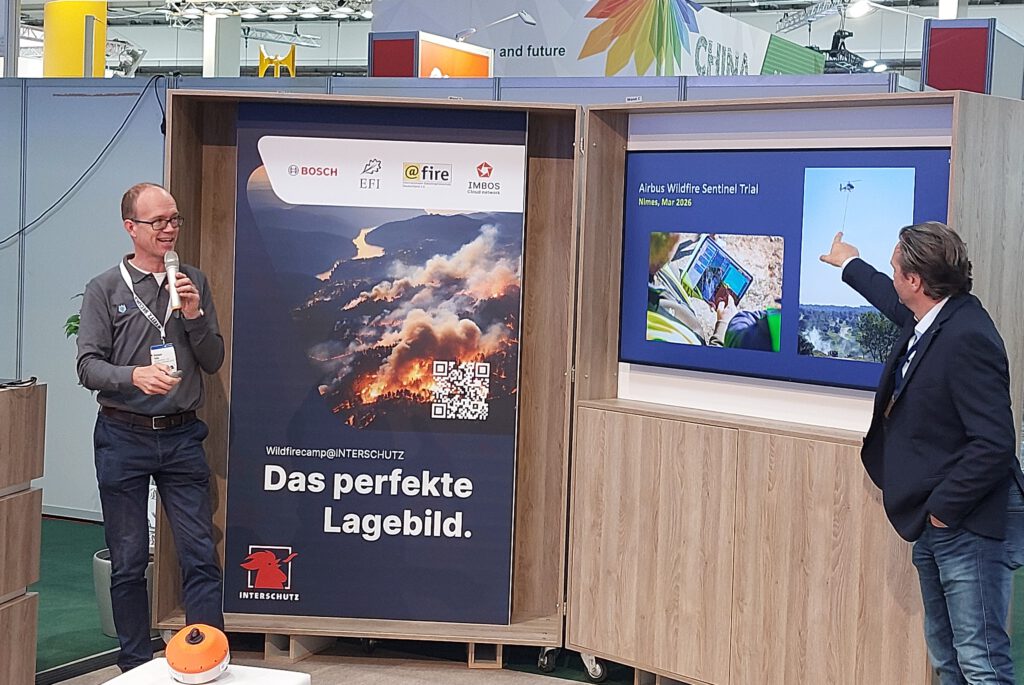
CAURUS Technologies was also represented with two innovation projects at WildfireCamp@INTERSCHUTZ 2026. Booth presence was also complemented by a panel discussion with representatives from Airbus talking about the role of innovation and helicopters in wildfire fighting. CAURUS Technologies and AIRBUS discussed their shared experiences with helicopter flights using the CAURUS-sensor. The speakers agreed that digital fire monitoring, as well as measuring and analyzing the effectiveness of water drops is becoming more important to achieve greater precision, efficiency, and safety for ground and airborne emergency personnel.
Georeferenced data for water impact analysis
he georeferenced images and measurement data generated by the CAURUS-sensor during a various helicopter flights could be viewed as part of projects “Forest Shield” and “AeroDrop”. “AeroDrop” is supported by the Future Forest Initiative’s Greentech Incubator. It’s goals is to establish a “Demonstrator Center Lower Saxony” for the sensor. There, the innovative technology system—comprising sensor-based fire monitoring and efficiency measurement of water drops—will be further developed in collaboration with local firefighters. Project “Forest Shield” was presented as part of the Forest Fire Fighting Transfer Laboratory. It is a joint project with Fraunhofer ITWM aimed at developing an analysis and simulation system for water drops.
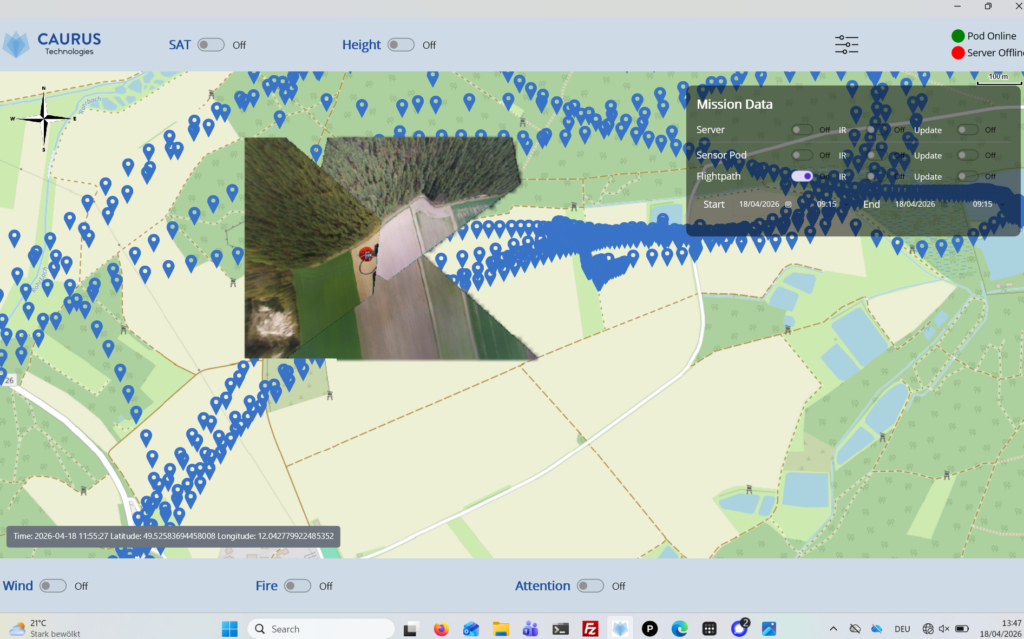
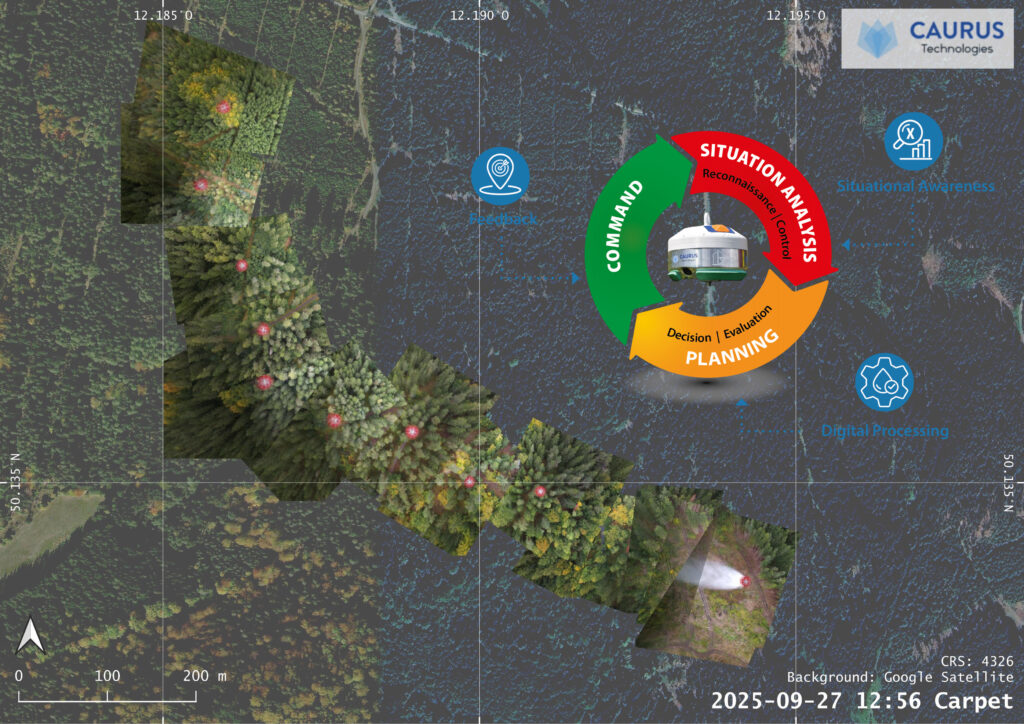
Both projects have in common that the georeferenced images and measurements data delivered by the CAURUS-sensor can serve as innovative decision-making tools for incident commanders and helicopter crews. The goal is to simplify the planning and execution of precise, efficient, and safe water drops. The sensor measures and analyzes, among other things, water distribution on the ground and changes in heat profiles. Relevant images and datasets, as well as processing software, were generated during more than 30 test flights of the sensor platform mounted underneath the helicopter.
Prediction and simulation are the future
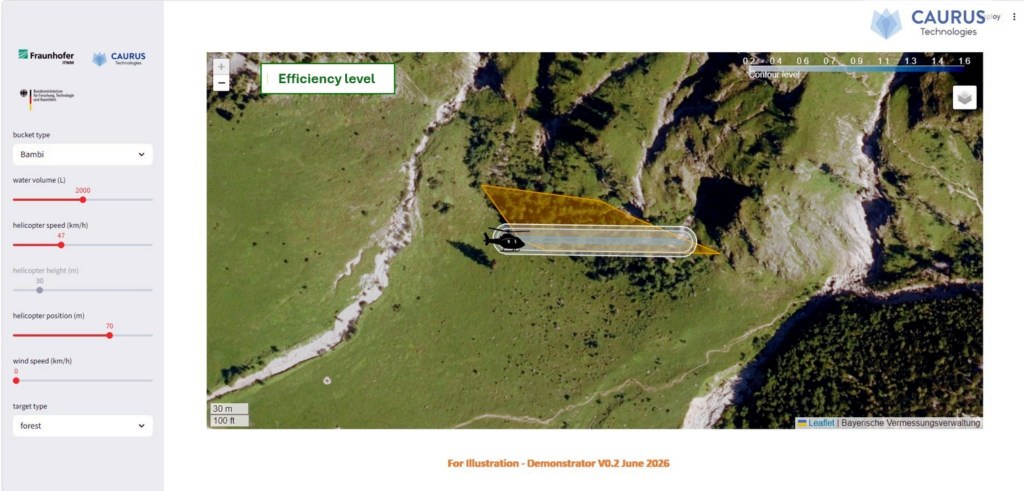
Of particular interest was the first preliminary version of the “water drop simulation system.” The system holds the potential to become another tool for incident commanders and helicopter crews to base the planning of targeted water drops within the command loop on actual data.